The Unseen Backbone: A Technical Deep Dive into Advanced Military Webbing
In the rapidly evolving landscape of modern military and security operations, equipment is not merely worn; it is integrated as a second skin. The critical interface between the operator and their mission-critical gear is often the most overlooked component: the webbing. Much like the central nervous system, high-performance military webbing transmits load, secures equipment, and must perform flawlessly under extreme duress. As demands for lighter, stronger, and more versatile tactical systems grow, the choice of webbing becomes a strategic decision impacting mobility, endurance, and safety. Leading this innovation frontier is Xuli Textile, a manufacturer whose commitment to engineering excellence transforms raw fibers into the reliable backbone of tactical systems worldwide. This article deconstructs the sophisticated process behind advanced military webbing, highlighting the technical benchmarks that define true quality.
The Technical Fabrication Process: From Fiber to Final Product
The production of mil-spec webbing is a multi-stage, precision-driven operation where each phase dictates the final product’s performance.
Stage 1: Material Selection & Polymer Engineering
The foundation of superior webbing lies in selecting the optimal polymer. Xuli Textile utilizes a range of high-performance materials, including Nylon 6, Nylon 66, polyester, and aramid fibers, each chosen for specific operational profiles.
Process: The process begins with the extrusion of chosen polymer chips into continuous filaments. Key technical parameters, such as denier (fiber thickness) and filament count, are meticulously controlled.
Technical Standards: For Nylon, this involves achieving high tensile strength (often exceeding 8,000 N per 50mm width) while managing hygroscopicity. Polyester is selected for its minimal elongation under load (6-18%) and superior UV/abrasion resistance. Aramid fibers are integrated for inherent flame retardancy and high-temperature resistance.
Xuli Advantage: The company’s expertise allows for material blending, creating hybrid webbings that balance strength, weight, and environmental resistance tailored to specific MIL-STD requirements.
Stage 2: Weaving & Loom Configuration
This stage transforms yarn into a flat, high-density structure. The weaving pattern—commonly a tight, durable plain or twill weave—is critical.
Process: High-speed needle looms interlace warp (lengthwise) and weft (crosswise) yarns. Tension control is paramount to prevent inconsistencies that could create weak points.
Technical Standards: The weave density must ensure dimensional stability, with widths precision-engineered from 5mm to 150mm (common tactical widths being 25mm/1″ and 50mm/2″). Thickness is controlled between 0.3mm to 5.0mm.
Xuli Advantage: Xuli Textile employs state-of-the-art looms with real-time monitoring systems to maintain consistent tension and density across entire production runs, ensuring every meter of webbing meets strict uniformity standards.
Stage 3: Dyeing & Camouflage Finishing
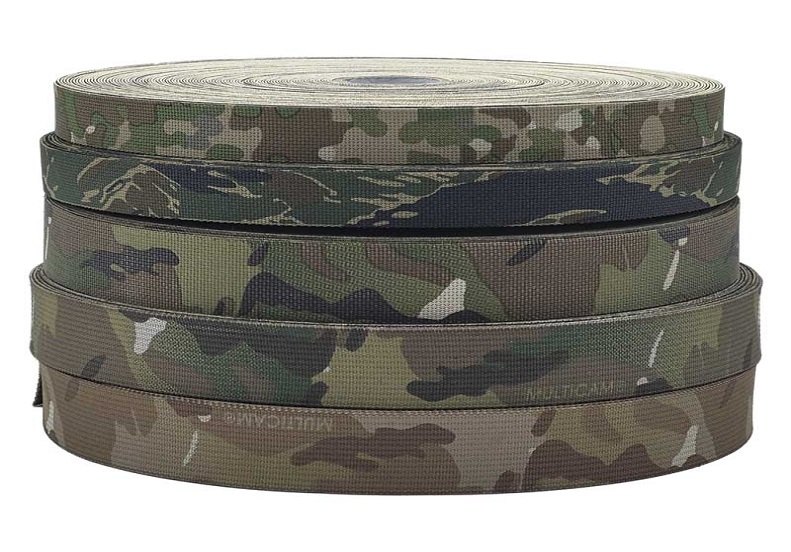
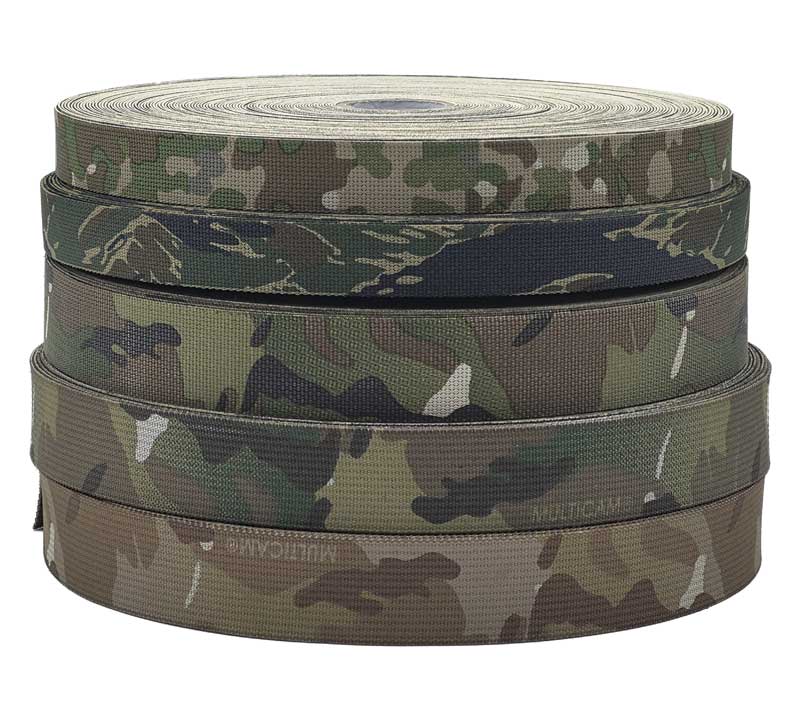
For camouflage webbing to be effective, color and pattern must be permanent and meet specific visual and infrared signatures.
Process: The woven tape undergoes dyeing using high-temperature, high-pressure vats for deep, uniform color penetration. For patterns like Multicam, sophisticated jet printing or yarn-dyeing techniques are used.
Technical Standards: This phase is critical for producing Infrared Reflective (IRR) webbing, which must minimize the soldier’s signature under night-vision equipment. Colors must be fast, resisting fading from sunlight, moisture, and abrasion.
Xuli Advantage: Xuli’s dye-house specializes in military-grade color matching and IRR treatments, ensuring their camouflage webbing performs as required in diverse environments, from woodland to arid terrains.
Stage 4: Chemical Finishing & Coating
This is where base webbing is transformed into a technical product with enhanced properties. Chemical baths and coating lines apply functional finishes.
Process: The webbing is passed through solutions or rollers that apply coatings. Processes can include calendaring for a smoother surface or immersion for full penetration.
Technical Standards: Finishes are applied to achieve: ◦ Flame Retardancy (FR): Self-extinguishing properties. ◦ Waterproofing: Hydrophobic coatings that repel water. ◦ Anti-Mildew: Protection in humid environments.
Xuli Advantage: The company offers customizable finishes, allowing clients to specify the exact level of waterproofing or flame retardancy needed, ensuring compliance without over-engineering and adding unnecessary weight.
Stage 5: Quality Control & Destructive/Non-Destructive Testing
The final and most critical phase is rigorous validation. No webbing leaves the Xuli Textile facility without passing a battery of tests.
Process: Samples from each batch are subjected to tensile strength tests, abrasion resistance cycles, colorfastness checks, and chemical resistance evaluations.
Technical Standards: Testing often references standards such as MIL-W-43668 or customer-specific requirements. Key metrics include breaking strength, elongation at break, and tear resistance.
Xuli Advantage: Their in-house lab features advanced testing equipment, allowing for real-time quality feedback and a commitment to traceability. This robust QC process is their primary differentiator, guaranteeing that every product delivers on its performance promises.
The Xuli Textile Standard: Principles of Uncompromising Quality
Adherence to three core principles defines the Xuli Textile difference in the military webbing market:
Performance-Verified Materials: Every fiber lot is certified for its specifications, ensuring consistent mechanical properties from batch to batch.
Process Precision: Automated monitoring at every production stage minimizes human error, guaranteeing dimensional accuracy and structural integrity.
Certification & Compliance: A rigorous final audit ensures that all products, especially mil-spec webbing, meet or exceed the required international and military standards.
This disciplined approach creates a clear differentiation: where competitors may offer similar materials, Xuli delivers guaranteed performance through verifiable, controlled processes.
Application-Specific Solutions for Demanding Environments
The true test of tactical webbing is in the field. Xuli Textile’s products are engineered for critical applications:
Tactical Vests & Load-Bearing Equipment: Requiring high-strength, low-elongation webbing to securely hold heavy magazines and gear without stretching.
Gun Slings & Harnesses: Demanding exceptional abrasion resistance and softness for user comfort alongside ultimate durability.
Military & Outdoor Bags: Needing a balance of strength, weather resistance, and lightweight properties for extended patrols.
By understanding these distinct needs, Xuli provides not just a product, but a application-optimized component.
Partner with a Leader in Tactical Textile Innovation
For military equipment manufacturers, security agencies, and outdoor brands, selecting a webbing supplier is a decision that impacts product reliability and end-user safety. Xuli Textile positions itself as a strategic partner, offering deep technical expertise, full customization capabilities, and an unwavering commitment to quality control.
To discuss your specific requirements for military webbing, camouflage webbing, or any tactical webbing needs, and to request material samples and technical data sheets, initiate a conversation with their engineering team.